Molotov Cocktease Cosplay Tutorial

The Iron curtain has fallen but not all Soviets are ready to reveal their secrets. This certainly holds true for the angelic assassin turned mercenary Molotov Coqtiz (Cocktease, we’re not afraid to say it). Still she can keep her secrets on a great number of things but some crafty Venture Brothers cosplayers have unraveled Mol’s secret to her slinky, sprayed on cat suit.

Joanie Mars, cosplayer of characters spanning multiple universes is also a huge Venture Bros. fan. Joanie’s translation of Molotov has earned her own fans so there is something to be said when the fans have fans. Start this costume out like all costumes, do your research, watch the show, take notes or better yet get screen captures of Molotov in action. Sure there may be plenty of images on the internet but they may not have all the angles you need OR give you the ability to scrutinize all the details.

THE BREAKDOWN

  • Red hair – Straight and parted over the right eye
  • Eye patch – Heart shaped and used on the left eye
  • Black Body Suit – With a deep revealing V in the front and even more revealing V in the back
  • Holsters – belt and straps. A dark red to maroon color
  • Gloves – Nearly elbow length and matching the straps and holsters
  • Boots – Almost knee high with stiletto heels and again matching the gloves and straps
  • Weapons – Kitana, C-96 broomhandled pistol, mini-Uzi, dagger


Bodysuit: The quick and easy method: Buy a black lycra/spandex bodysuit in your size then apply the relevant directions below for creating the front and back V’s. With the suit on she measured her body and drew a line from her collar down to just about her pantyline for the front V. In the case of the rear V she made the depth of that one slightly longer than the front. This is to reveal the more cheeky aspect to Molotov.Then following that line she cut straight down almost like making the opening incision in an autopsy. It’s crucially important though that when cutting the V’s to NOT cut a lot of material on your first go around. A single cut straight down will make the stretch material expand outward. From there then you can adjust and gently remove more bits of material as needed. Leave yourself plenty of material so that you can hem those cuts under. She left approximately ¼ inch hem allowance for the front and rear V’s but remember this is stretch material and stretching it too much while sewing will distort the finished product so give yourself enough hem material for you to be comfortable with. In this occasion Joanie created the bodysuit from a neoprene/spandex blend. She wanted something thicker and shiny. The neoprene is a rubbery material often found in wetsuits and gaskets. To make the waist and small of the back even more curvy she added darts (no fellas not the kind of darts you find in bars) to take in more of the fabric and make it more form fitting. Ladies who have worn these bodysuits will know that the material likes to stretch in the straightest most direct lines between points of tension. In this case that would be from the butt to the shoulder blades. Adding the darts forces the material to following the back.

Holsters: Here is a word of wisdom from an experienced cosplayer, Joanie recommends first acquiring your props for the holsters or sheathes. You have any number of weapons you can use but analyzing the show Mol frequently has; a hunting style knife or dagger, a C-96 broomhandle pistol, a mini-Uzi like in “Assassinanny 911” and a Samurai sword. The props, specifically the sword, knife and C-96 all have holsters or sheaths. Using the same stretch vinyl as what you’ll need for the gloveswrap the weapons and measure enough material to cover each with some extra for the seams to be folded and hemmed. Then a thicker, stiffer material can be acquired to act as the rigid portions in a holster which maintain the holster’s shape. This material should be cut out to match the outer red vinyl. So you have 2 materials cut to the same shape. The inner thick material should be sewn to one side of the red stretch vinyl. Now instead of 2 matching patterns you’d have one single piece with thick vinyl on one side and the red stretch material on the other.Then enclosing the thicker material the holster or scabbard would be folded over and sewn shut so that the red stretch material would appear on the outside. The holster straps are made from the red vinyl. One method would be to take lengths longer than what you know you’ll need and fold them over until you have nice uniform edges. For instance the thigh strap for the holster can start as a piece of fabric 20” long by 4” wide. Then create folds on the 4” side, one coming down 1.25” inches and one coming up 1.25” (you lose a partial inch in the bend of the fold). That means you have a 20” length of red stretch material that is only about 1.25-1.35 inches tall but is 3 layers thick. Then sew down the folds to have nice professional edges. You can then wrap that piece around your leg and check the length, cutting off any excess. You will have to employ a method similar to this for each of the straps, the belt and parts of the holster. Some straps, like the ones for the knife which goes on Mol’s arm can be narrower than 1.25 inches so keep your sewing pins handy and adjust the widths to meet your own aesthetic tastes. For the belt again the same matching red was used but rather than just folding it over again a more supportive material was inserted (like the holsters) and used as a partial spine so that the belt wouldn’t be flimsy.

Gloves: Get 3 yards of materials so that you can make the holsters and gloves all from the same material. With the gloves Joanie also made those from scratch. Place out you hand and arm spreading your fingers onto a large sheet of paper, or sheets of paper taped together to accommodate your hand and arm with enough extra space so that you can trace. Then trace out your hand and arm, if you are a good freehand artist you can automatically just draw and image of your arm and hand about ½ – ¾ of an inch away from your fingers and arm. If you directly traced your arm then you should now create a duplicate tracing but make it outside that first tracing and again set it ½ -3/4 of an inch away from the original tracing. Why so far out? This is the extra material you’ll need to both wrap your hand AND have enough to sew to. Now for the thumb specifically, imagine where your life line is on your palm. That long curved line which isolates your thumb from your hand. Mimic that on your drawing and then when you go to cut out your traced hand and arm be sure to also remove the thumb cutting along that imaginary life line. With you paper pattern made trace it out four times onto your red stretch vinyl. Be sure you have two sets facing each direction otherwise you might end up with 2 left gloves or 2 right gloves. It helps prevent confusion if you cut these individually as in thinking to yourself “this is the left hand… and this is the right hand”. Now you should have four pieces of material cut resembling 4 fingered hands and partial arms. With the facial side, the side you want to be seen, facing toward each other and all the fingers and arm sections line up between sewing the outer edge of your glove. Follow around the edges and be sure to back stitch and reinforce between the fingers and wrists. Since these areas bend the most on our hands the gloves will have the most stretch and wear here.

Boots: Mol’s boots can be bought ready to go but if you have the chance you might want to bring a sample of the glove material with you as you shop for the boots. That way you can try and get the best color match possible. If you’re shopping online then you’re at the mercy of the color of the screen and accuracy of color correction of the camera that took the sample photos. Still there are plenty of boots out there that will work.


Written by John McDonald with Joanie Mars, Venture Bros. Cosplay

Discuss this story in our Venture Forums! Follow @VentureBrosBlog on Twitter and be sure to “LIKE” us on Facebook for the latest Venture Bros. news!

[Venture Bros. Blog]

The Venture Brothers Christmas Catalog 2011

With Christmas just around the corner, here’s our Christmas Catalog of officially licensed Venture Brothers merchandise from Adult Swim Shop. Black Friday sucks, so here’s our handy guide to Christmas shopping online.


Shallow Gravy
Band T-Shirt
$18 – Shop Adult Swim

Shallow Gravy
Jacket EP
$5 – Shop Adult Swim

The Venture Brothers
OST Album on CD
$12 – Shop Adult Swim

The Venture Brothers
OST Album on Vinyl
$18 – Shop Adult Swim

The Venture Brothers
Season 1 on DVD
$24 – Shop Adult Swim

The Venture Brothers
Season 2 on DVD
$24 – Shop Adult Swim

The Venture Brothers
Season 3 Blu-ray Edition
$38 – Shop Adult Swim

The Venture Brothers
Season 3 on DVD
$24 – Shop Adult Swim

The Venture Brothers
Season 4 Volume 1 DVD
$20 – Shop Adult Swim

The Venture Brothers
Season 4 Volume 2
$20 – Shop Adult Swim

The Venture Brothers
Season 4 Blu-ray
$38 – Shop Adult Swim

The Venture Brothers
Patch Set 2
$12 – Shop Adult Swim

The Venture Brothers
Lunch Box & Action Figure Set
$45 – Shop Adult Swim

The Venture Brothers
Action Figure Set 2
$40 – Shop Adult Swim

The Venture Brothers
Action Figure Set 1
$40 – Shop Adult Swim

The Venture Brothers
‘Sienkiewicz’ Art Print
$24 – Shop Adult Swim

The Venture Brothers
Brock Action Figure
$20 – Shop Adult Swim

The Venture Brothers
Dean Action Figure
$20 – Shop Adult Swim

The Venture Brothers
Monarch Action Figure
$20 – Shop Adult Swim

The Venture Brothers
Dr. Venture Action Figure
$20 – Shop Adult Swim

The Venture Brothers
Brock Samson Bobble
$20 – Shop Adult Swim

The Venture Brothers
Dr. Mrs. Monarch Bobble
$20 – Shop Adult Swim

The Venture Brothers
The Monarch Bobble
$20 – Shop Adult Swim

The Venture Brothers
Dr. Orpheus Bobble
$20 – Shop Adult Swim

The Venture Brothers
Canvas Art Print
$200 – Shop Adult Swim

The Venture Brothers
Acrylic Clock
$35 – Shop Adult Swim

The Venture Brothers
Pair of Shot Glasses
$15 – Shop Adult Swim

The Venture Brothers
Hatred Water Bottle
$15 – Shop Adult Swim

The Venture Brothers
Magic Murder Bag
$50 – Shop Adult Swim

The Venture Brothers
iPhone & iPod Skins
$10 – Shop Adult Swim

The Venture Brothers
Monarch Journal
$18 – Shop Adult Swim

The Venture Brothers
Magnet Set
$15 – Shop Adult Swim

The Venture Brothers
Killinger Necktie
$40 – Shop Adult Swim

The Venture Brothers
Guild Tie Tack
$25 – Shop Adult Swim

The Venture Brothers
Venture Cuff Links
$40 – Shop Adult Swim

The Venture Brothers
O.S.I. Track Jacket
$50 – Shop Adult Swim

The Venture Brothers
Hatred Military Socks
$15 – Shop Adult Swim

The Venture Brothers
Guild Baseball Cap
$20 – Shop Adult Swim

The Venture Brothers
Hatred Military Cap
$20 – Shop Adult Swim

The Venture Brothers
Venture Industries Belt
$20 – Shop Adult Swim

The Venture Brothers
Brock Baseball Tee
$25 – Shop Adult Swim

The Venture Brothers
Guild Crest Hoodie
$50 – Shop Adult Swim

The Venture Brothers
Lightweight Hoodie
$40 – Shop Adult Swim

The Venture Brothers
Guild Hoodie
$45 – Shop Adult Swim

The Venture Brothers
Family of Action Shirt
$18 – Shop Adult Swim

The Venture Brothers
Order of the Triad Shirt
$18 – Shop Adult Swim

The Venture Brothers
S.P.H.I.N.X. T-Shirt
$18 – Shop Adult Swim

The Venture Brothers
Venture Industries Shirt
$18 – Shop Adult Swim


Discuss this story in our Venture Forums! Follow @VentureBrosBlog on Twitter and be sure to “LIKE” us on Facebook for the latest Venture Bros. news!

[adultswimshop.com]

Entertainment Earth Black Friday Sale

Heads up, bargain shoppers! Entertainment Earth is ready to give you amazing deals today– you don’t have to wait for Black Friday! Get the latest and greatest toys, action figures, bobble heads, and collectibles in time for the holidays, and get them at incredible Black Friday discounts from Entertainment Earth. Choose from terrific deals that are sure to light up the eyes of everyone on your gift list– and be sure to come back later this week for even more Black Friday savings! FREE SHIPPING until December 12, 2011!

» Check Out Entertainment Earth’s Black Friday Week – Sneak Peek

Discuss this story in our Venture Forums! Follow @VentureBrosBlog on Twitter and be sure to “LIKE” us on Facebook for the latest Venture Bros. news!

[Venture Bros. Blog]

Brock Samson Cosplay Tutorial

If you’re looking to start in costumed aggression, there’s no more appropriate Venture Bros. cosplay than Brock Samson. We’re going to focus on the original Brock outfit here, a costume you can create purely off-the-rack, which is great for beginners. There will be small creative suggestions on some items, but not in detail since the focus of this tutorial is ready-made costuming. As easy as this will be to put together, this is not an outfit to be worn casually, you’ll need to adapt the Swedish Murder Machine mentality to sell it. We recommend getting your OSI License to Kill first, click the link below for that. What? You didn’t think portraying Brock F-ing Samson was going to be that simple, right? Oh, you did. Well then, let’s get your training started. You can’t rock this if you’re as soft as a wad of cookie dough.

» Click to get Brock Samson’s OSI License to Kill

List of Items Needed:

1-Penguin Shirt
2-Green Pants
3-White Slide Shoes
4-Mullet & Sideburns
5-White Belt
6-Bowie Knife

THE COSTUME BREAKDOWN

Penguin Shirt: This can be found at several major retailers and on the web. The key to finding this polo is that the style is called ‘The Earl’, don’t just type in Penguin Polo or you’ll sift through everything else made by the brand. You want the solid black with the white trim. They run around $60 retail, but are sometimes found for less on sale or sites like eBay.

*Additionally, if you’re down with crafting, you can modify a far cheaper black polo. You’ll just have to add the white trim on the sleeve cuffs, around the collar edge, and outlining the chest button placket. This can be done through a variety of ways: sewing white cloth or bias tape to the shirt, masking off the lines with tape & using many layers of fabric paint, or cutting down iron-on fabric tape(comes in a one inch width) and applying that to the edges. All the products for those options can be purchased at a local fabric store or Jo-ann’s, just ask a salesperson where to find them.

Green Pants: I would recommend green khakis for this one, they’ll have the look and the bonus of comfort. Finding ones the pea pod shade that Brock wears is the tricky part, but you can fall back on the traditional army green if you cannot.

If you’re going for accuracy and want the ‘split pea soup’ green, you can always create your own. You can either procure fabric and sew pants, or purchase white ones and dye them. If you go the dyeing route, RIT liquid dye is best for mixing and easier than the dry. Also, RIT has an amazing color formula chart on their website to help you know what to buy to make the shade you desire. The formula I recommend is #41 under the Yellow-Green chart, #263 if you want a lighter look or depending on the material. Read all the fabric recommendations and dyeing advice on the site before starting, dyeing can be full of surprising results without proper preparations.

White Shoes: Brock wears a white loafer/slide shoe. These can be found all over for very little in a canvas material. If you want leather or the look of such, you’ll have to fork out more and they’ll be more accessible in internet stores.

*Crafters can always find used slide shoes at a Goodwill or thrift store and add white fabric paint(Tulip brand matte sheen) to get the right color on a leather or synthetic pair. Just be sure to clean the shoes thoroughly with rubbing alcohol before applying paint. It should take 3-4 thin layers to get a solid coat. A sponge tip brush will give the smoothest application; they are sold in packs in dollar, hardware, and craft stores.

Murderous Mullet: To achieve Brock in all his glory, a luscious mane of blonde hair will be the cherry on top. If you cannot find a proper mullet wig easily, a curly shoulder length ladies one will do. Then you can just trim back the sides to get the right ‘business in front/party in the back’ appearance only this hairstyle can channel. You can try costume stores or places like Party City for basic ones, a wig store if you want to go higher end in quality and pricing. Also, don’t forget the fake sideburns! The best way to apply those babies is with a magical product called Spirit Glue. Pick up the pack that carries the remover in it as well. This retails around $6 at most costume/party stores.

White Belt: Do not confuse Samson with the average hipster, he donned a white belt before any of them were even born. This should be an easy find and his is plain with a silver rectangular buckle. You can go the leather/synthetic route, but it will probably come with an open buckle face instead. Brock’s belt looks to be the fabric variety with the solid steel slide buckle-which is a military style.

*Having trouble finding the right white belt? Purchase a proper black one and use about 4 layers of Tulip matte fabric paint to turn it white.

Bowie Knife: There’s two ways you can go with this, the real route or the toy one. A prop is best since you can carry it unsheathed, pose with it in your mouth and a violent twinkle in your eye, and generally be less likely to dismember anyone accidentally. This is typically called a Bowie (I half wonder if  Doc Hammer chose it out of his sheer love for David) or a survival knife. It is common so it can be found in costume and even some toy stores. Online will give you a broader selection in style and price. Some may choose the real thing since they come in the same price range, but you will be limited to keeping it in its holster. Conventions have a weapons policy and true ones must be ‘peace-bonded’ at all times. If you go the holstered route, make sure it sits in a golden brown leather look one.

ADDITIONAL RECOMMENDATIONS

Muscles: If you’re not built with a similar physique as Brock, one way you can fake it is with a classic ‘muscle shirt’. Many costumers carry these, it’s a shirt padded just so, so that when worn under his Penguin Polo, it’ll give the bulk you’re looking for.

Communicator Watch: Since this is a pure from scratch item, it doesn’t fall under the parameters for this tutorial.  We’ll have a step-by-step guide for one coming soon, so check back!

Written by Susan Blix, Venture Bros. Cosplay

Discuss this story in our Venture Forums! Follow @VentureBrosBlog on Twitter and be sure to “LIKE” us on Facebook for the latest Venture Bros. news!

[Venture Bros. Blog]

The Monarch Cosplay – Chest Armor

The Monarch’s Chest Armor is the defining piece of his costume; the Piece De Resistance. Or whatever. It’s the biggest piece to make (literally), the most challenging, and ultimately the single most important/obvious one.

Our Chest Armor is made of Wonderflex (WF). Making the Armor out of WF allows you to make it one large piece, with a single seam up the back – no complicated fasteners needed. The process involves making a fitting assistant or Clone of yourself, “sculpting” the armor Form on top of that, then curving the WF over your Form to create the finished piece.

Ductape, fiberglass, and sexy black paint.

WF is easiest to work with when you have something to shape it ON. You can work it by hand, but that gets tedious. The easiest way to do this for armor is to start with a torso. You could use a mannequin, or cast your body in plaster. Or you can easily and cheaply make a copy of your own by Cloning Yourself using duct tape and stuffing/batting. Just follow the instructions there – all you need is some tape and a henchman.

Once you have your Clone, sturdy him up a bit. We layered some fiberglass and resin on our Clone to make him more rigid, so he’d stand up to the constant maneuvering and abuse he was about to undergo, then painted the whole mess because we like black. Remember: Layering WF requires both heat and pressure, so you’ll be applying decent force to this thing. You don’t need to reinforce it, but it helps when shaping the WF, and will make your Clone last longer – focus especially on the upper neck/shoulders, and the chest. Don’t make the sleeves too long or stiff, since you’ll have to get the armor around them to get it off the Form later – just long enough to see where things should go. NOTE: Our first Clone got warped/smushed making our first set of Armor – the shoulders and neck were too fat to be useful and we recycled it into this one.

Cardboard and joint-tape Form.Now it’s time to make your Armor Form. You’re going to “sculpt” the shape of your Armor right on top of the Clone you just made – that way you know it will fit. The first time we did this, we used only cardboard, thinking we could smooth out the WF by hand later on. NOTE: This was a mistake – it is difficult and very time-consuming to change a small portion of a piece like this without altering everything around it. The second time we started with cardboard, and finished with a layer of Bondo Body Filler.

Start with cardboard for your basic shape. NOTE: If you want to make it easier to remove the Form from your Clone when you’re done, wrap the Clone in paper or plastic wrap first. Then go crazy with the cardboard and tape. Masking tape is perfect because it’s cheap, flexible, and you can cut/sand through it with ease if you need to later. Remember: You’ll want a decent amount of space inside the armor so you can move – things like bending and twisting your torso are painful/impossible with armor that’s too tight, so put some thickness in those first layers. Keep in mind what the final shape will be, but don’t hesitate to slap cardboard wherever you need it to make the shape look right. NOTE: Use tape to cover edges and gaps between cardboard pieces – the less space you have to fill with Bondo the better. We also used fiberglass drywall-joint tape to make the Bondo stick better – this is strictly optional.

When you think you’re close to the shape you want, draw the final outline directly on your cardboard Form. Cut off any extra cardboard with a box cutter, making sure to reattach anything that comes loose. NOTE: We did not do this, and we were forced to go back after starting with the WF and cut clean edges so we could properly shape our Armor.

First coat of Bondo, unsanded.At this point you should have a rough cardboard version of what your Armor will look like. It should be slightly smaller than you want the final piece to be, because you are about to slather it with Bondo. NOTE:Gauging exactly how much cardboard versus Bondo to use is tricky. Ideally you’ll use just enough Bondo to smooth everything over and create the elegant, complex curves you want. In practice this rarely happens. You will almost certainly have areas with too much cardboard, and areas with too little.
After first round of sanding, front.Although you will need a lot of Bondo (we used nearly a gallon), work in small batches. Remember: Bondo hardens faster with sunlight and heat, so work away from both. We recommend using the actual Bondo/3M brand spreaders you’ll find wherever you buy your Bondo – they’re flexible, and make curves easier than rigid spreaders will. NOTE: Don’t try to get everything perfect with the first layer. As we said, it’s likely you’ll have some areas that need more work than others. Get a solid coating of Bondo on everything first, then go back and add more where you need it.

Once the Bondo looks good, it’s time for sanding! You really, really want a power sander. Even if it’s a crappy square sander from a swap meet or garage sale, get one. Start with some really heavy 60 grit sandpaper. Depending on the shape of your Armor, and how smooth you made your Bondo, you might want to start with a heavy-duty rasp/file. Go crazy – shape the Bondo down to where you want it, using whatever tools are easiest. We used a combination of heavy rasp, Dremel, square and random-orbital sanders.

Completed Armor Form.When you have the shape almost perfect, switch to a higher grit sandpaper, like 220. The Bondo doesn’t have to be paint-grade smooth, but the WF will pick up a surprising amount of detail when you heat it up as much as you’re about to do.

You might sand through the Bondo and expose your cardboard, but still want to carve the Form down farther. Just cut out the exposed cardboard, plus a healthy chunk of the area around it, with a box cutter. Then put more Bondo in the gap you made and continue sanding. If you find areas/gaps that should stick out more, just add more Bondo (and/or cardboard) and keep sanding. You can repeat this process infinitely, or until you’re satisfied with the results.

First layer of WF.When you’re happy with the Form, it’s time for the WF. NOTE: If there is any exposed cardboard or tape, cover the Form with tin foil. WF gets very sticky when hot, and though it will peel off Bondo fairly easy it won’t come off cardboard or paper (like masking tape). Tin foil peels right off, as does plastic wrap – but plastic wrap can’t withstand the heat. We recommend clearly marking things like center lines before you get started – it makes it easier to get things symmetrical later.

WF now comes with a “smooth” side and a textured side. It sticks to itself regardless of which side you use. Make the armor two layers thick – it will be sturdier and hold its shape better. We recommend putting the smooth side in for the inner layer, and out for the outerlayer. This will make it easy to paint, and leave fewer rough edges to snag clothing/skin on.

WF seams, close up.Start with a great big piece of WF for the first part. You can make a rough pattern using paper if you like. Remember: WF stretches in proportion to its size, so  big piece will stretch a lot. Start from the front – you want the front to be the smoothest and most polished looking. Work your way around, stretching, smoothing, and pressing the WF onto your Form. Cut and trim as needed to make things lay smoothly. Tack edges down with masking tape if it moves too much. With patience and effort, you can make the WF exactly match your Form.

After the front piece is done, do the same from the back, overlapping the pieces when you get to the sides. Trim the edges of both halves before overlapping – this will create cleaner lines later on, and make any extra smoothing easier. When starting with a new piece of WF, start forming either from the center (if it’s a new section), or from the edge you’re overlapping (if continuing from an adjacent piece). If you don’t, you may end up with wrinkles at the overlap if you have to stretch the WF further. NOTE: Wrinkles are a pain to fix, are ugly, and create extra-stiff areas – usually where you don’t want them; avoid them.

Continue like this, adding new pieces of WF until the whole Form is covered. Add extra layers in high-stress areas like the shoulders and the center of the chest. Remember: WF will bond to itself when hot – if both layers are hot enough they fuse into one solid layer. Reinforce any spots that seem weak, or where you cut sharp corners – like the front “V” shapes. We recommend trimming and rolling/folding the edges under – it adds another layer of stability, and creates a nice smooth appearance. We shaped the front edges to be almost triangular, making the armor look much thicker than it actually is.

Smoothing second layer WF.NOTE: WF will pick up enough detail from sub-layers that edges will show through to the top layer – be careful when layering. To hide/smooth any lines from hidden layers/edges, get the area good and hot and roll over it with something like a pen – a sharpie works well because of its slightly curved shape.

NOTE: WF normally retains heat, and Bondo acts like an insulator – it’s convenient to have a fan handy to cool off the areas your working on as you hold them in place. The most time-consuming aspect of using WF, especially on a large piece like the Armor, is waiting for one section to cool so you can move onto the next one.

When all the WF is done and completely cool, it’s time to take it off your Form. Find the center line on the back of the piece – this is where you’ll cut. NOTE: This is one place where it’s especially important to double-check everything. Cut completely through all the layers of WF from the collar to the bottom edge. Double check that the layers here are completely bonded to each other – you don’t want them to separate when you attach the fasteners.

Now comes the moment of truth! Peel the WF off your Form. It will stick, so proceed slowly. A flexible putty/spackle knife may be helpful to pry loose any especially stubborn parts.Remember: WF loses its flexibility if it’s especially thick – places like the shoulders can actually crack/break if you’re not careful. NOTE: If anything breaks, don’t worry – enough heat and pressure and the edges will melt right back together, and some WF scraps underneath will ensure the area is solid.

Completed WF Armor.When the whole piece is loose, it should come right off the form – some bending and contorting may be required. When it does, congratulations! You now have a piece of armor that will fit you perfectly. Go ahead and try it on to be sure, but have a henchman handy – getting back out can be tricky.

The next stage is painting. You’ll prime your everything first. Use a flexible automotive High Build primer, coupled with a flexible Adhesion Promoter. Bulldog makes both, and they’re commonly available at auto supply stores. The Adhesion Promoter ensures the primer bonds with the plastic of the WF and can flex/bend adequately, and the High Build primer will make it easy to get the Armor looking glossy-smooth. There are cheaper High Build primers (Home Depot sometimes carries a Rustoleum version), but they don’t have the flexibility and bonding strength of good auto primers. Remember: The quality of your primer is what determines how well the surface coat sticks to your final piece.

WF Armor, 3/4 view.Coat everything with primer, including any parts of the inside which can be seen through arm holes, from underneath, etc. We painted everything to be safe. At this point, check that everything is smooth, with no visible seams/lines – edges and overlapping pieces are prime locations. Any areas that need work can be further smoothed with a thin layer of Bondo.NOTE: It is easier to see imperfections after everything is primed the same uniform color, which is why you’re doing this now. When it looks OK, apply more primer until you have enough paint to sand everything smooth.  Once the primer dries, sand it lightly until it feels sleek – start with 120 grit, then move on to 220, and finish with 300.
Letting the paint dry.Dust/clean everything thoroughly, then paint it. There is a sparse selection of yellow aerosol paint – Rustoleum and Krylon each make 2 colors. Montana Gold (available at Blick and other art stores) comes in about a dozen shades, but is only available in matte finish. We used Krylon gloss yellow. It goes on very, very thin, but dries to the touch and is repaintable in about 10 minutes. Be patient, and expect to use several cans (we used 3). It will take many coats to get a consistent, solid yellow, but the finish is very smooth and durable.

Once all the paint is fully cured it’s safe to move on to attaching fasteners and harness. Our armor uses a separating zipper to close the back seam, but you can also use velcro or something similar. NOTE: Make it simple – someone else will be strapping you into your armor. Barge Cement (available at hardware and craft stores) works excellently, and will bond to anything you use here.

Foam and Bondo shoulder form.Unless it is secured to your body, the Armor will ride up to you neck. To keep it in place, we snap it to an elastic harness straps around the chest. We started with a set of hockey pads found at a second-hand sporting goods store, cut off all the plastic and extraneous bits, and sewed heavy-duty snaps to the shoulder/neck portion. Then we used Barge to attach the other half of the snaps to the underside of the armor. You could create a similar setup from scratch using elastic and velcro. NOTE: Double check that everything lines up correctly before attaching anything – your Clone will be useful here.
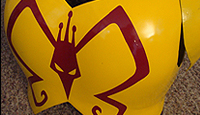
Final WF Chest Armor.The shoulder pads are made of WF, following the same method used for the Armor. Except instead of using cardboard we used expanding foam insulation (comes in a can at hardware stores), which we carved with a serrated knife, then covered with Bondo. It was easier making the curve of the shoulders this way than cardboard would be. They are attached directly to the Armor with a piece of yellow fabric – in our case scraps from our boots, so it matches everything else. The wings are secured with a single strip of velcro, glued on with Barge. You can make the Monarch logo with vinyl decal material from craft stores, though we had ours professionally printed from an Adobe Illustrator image we drew. In fact, you can ask Jennifer Allman to print one up for you, too – she has them ready to order.

That’s it, your Armor is done! Now get suited up and go show the world just how malevolent you truly are!

Written by Steven Meissner, SoloRoboto Industries


Discuss this story in our Venture Forums! Follow @VentureBrosBlog on Twitter and be sure to “LIKE” us onFacebook for the latest Venture Bros. news!

[Venture Bros. Blog]